
Last Updated on July 15, 2026
by David Flatcher
Best Poker Sites Not on GamStop: Online Non-GamStop Poker Rooms for UK Players (2026)
Poker sites not on GamStop are offshore-licensed poker rooms that sit outside the UK’s self-exclusion scheme. You can join them whether or not you’ve ever registered with GamStop, because they’re regulated by authorities like Curaçao, Malta or Anjouan rather than the UKGC.
This isn’t a beginner’s tutorial on what a wager is. It’s a practical look at what actually separates a solid non GamStop poker site from a mediocre one — rake, rakeback, licensing, traffic, and how the bonuses genuinely work once you sit down at a table. If you already know your PLO from your NLHE, skip ahead to the comparison criteria. If you’re newer to this corner of the market, the next couple of sections will get you up to speed fast.
Best Online Poker Sites Not on GamStop for UK Players
















Poker Sites Not on GamStop Compared
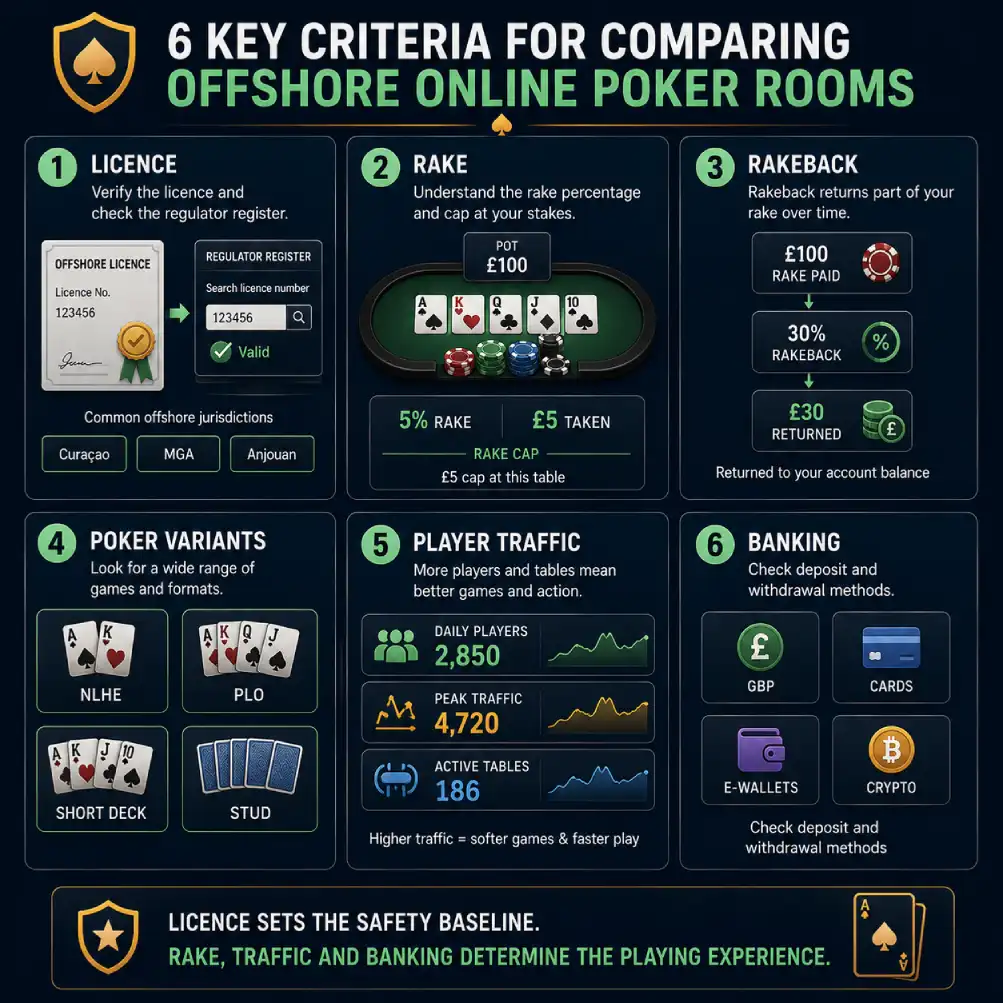
Not every non GamStop poker site deserves your bankroll, and headline bonus size tells you almost nothing on its own. Here’s the framework we use to judge them, and what “good” actually looks like on each metric.
| What to check | What a strong site typically offers | Why it matters |
|---|---|---|
| Licence | Curaçao Gaming Control Board, Malta Gaming Authority, Anjouan | Sets the floor for fund segregation and RNG certification |
| Rake | 3%–5% at cash tables, with a stated rake cap | High rake with no cap quietly eats your win rate |
| Rakeback | 20%–50%, flat or tiered via a VIP scheme | Directly offsets the cost of every hand you play |
| Poker variants | Hold’em and Omaha as standard, Short Deck at better sites | Wider variety means the room takes poker seriously, not just as a side product |
| Traffic | Four figures of daily players at a strong room, into five figures at peak | Thin traffic means long waits and capped stakes |
| Banking | Crypto plus at least two of: cards, e-wallets, bank transfer | Crypto for speed, fiat as a fallback |
Genuine non GamStop poker sites are offshore-first operations — think Curaçao- or Anjouan-licensed platforms built around crypto banking and international player pools. Be wary of any list that quietly slots in the big UKGC brands (Partypoker, 888poker, PokerStars, Betfair and the like). Those are UKGC-licensed, GamStop-linked operators. If you’re self-excluded, they won’t let you in — no matter what a comparison table might imply.
What Is GamStop and Why Are Some Poker Sites Blocked by GamStop?
GamStop is a free self-exclusion tool. It lets you block your own access to every UK-licensed gambling site — casinos, sportsbooks, and poker sites alike — in one go, for a period you choose between six months and five years.
Every operator holding a UKGC licence has to check the GamStop register and block anyone who’s signed up. It’s not a law. It’s a condition the UK Gambling Commission attaches to its licences. Once you’re on it, you can’t get back into a UKGC site until your exclusion period ends, and it renews automatically if you don’t act in time.
That’s exactly why non GamStop poker exists as a category. Offshore rooms licensed in Curaçao, Malta or Anjouan don’t check the GamStop register, because they were never required to. Nothing about that arrangement is illegal — it’s simply a different regulatory perimeter.
Is It Legal for UK Players to Use Poker Sites Not Blocked by GamStop?
Yes. There’s no UK law stopping an adult from registering at an offshore poker room. The UKGC licenses operators, not players — its rules only bind the sites it regulates.
Offshore rooms carry their own licences from bodies like Curaçao eGaming or the Malta Gaming Authority, which impose their own standards on fairness and fund handling. What you give up is UKGC-specific protection: there’s no UK Alternative Dispute Resolution body standing behind an offshore operator if something goes wrong. Your recourse runs through the licensing jurisdiction instead, and that process moves at a different pace to what you’d get from a UK regulator.
That distinction is important for UK residents because playing offshore is not the same as using a site licensed by the UK Gambling Commission. It may still be legal for UK residents, but the protection framework is different.
One thing that trips people up: poker winnings aren’t taxed in the UK regardless of where you play. HMRC treats gambling duty as the operator’s problem, not the player’s, so a big score at an offshore site is no more taxable than one at a UKGC site.
Why UK Players Choose Online Poker Not on GamStop
Players don’t move to offshore poker on a whim. A handful of recurring reasons show up again and again.
Continued access after self-exclusion. If you’ve activated GamStop — often during a period when you needed a break — and you’ve since decided you can manage your play responsibly, offshore rooms are one of the few routes back to real-money poker without waiting out the exclusion period.
Bigger, less restricted bonuses. UKGC promotional rules have tightened considerably. Offshore operators aren’t bound by those limits, so welcome offers and rakeback deals tend to run larger, with fewer of the caps UK players have become used to.
Wider stakes and formats. Non-GamStop sites typically pull from global player pools rather than a UK-only base. That usually means deeper game selection at both ends of the stakes ladder, and formats like Short Deck that are harder to find on domestic sites.
Crypto-first banking. Deposits and withdrawals in Bitcoin, Ethereum or a stablecoin clear far faster than a card or bank transfer, and they come with a level of privacy that UK banking rails simply don’t offer.
Lighter verification at signup. Many offshore rooms only ask for identity documents at your first significant withdrawal rather than before you can play a hand. That’s convenient — it’s also one of the trade-offs worth weighing, since it reflects lighter oversight generally.
None of this makes offshore poker a free-for-all. It just means the calculation shifts from “which UKGC site has the best loyalty scheme” to “which offshore site is actually reputable, and how do I check that for myself.”
For some players, the appeal is simple: sites not on GamStop offer access to larger international pools, more flexible bonuses and fewer UKGC-style restrictions. The trade-off is that sites are not regulated by the UKGC, so you need to judge the licence, reputation and withdrawal record yourself.
How to Choose the Best Online Poker Site Not on GamStop
Six things separate a site worth your bankroll from one to avoid. Work through them in this order, because licensing gates everything else — a great bonus at an unlicensed site isn’t worth the risk.
If you are comparing the best non GamStop poker sites, focus less on the headline bonus and more on whether the site has a real licence, fair rake, visible traffic, workable banking and clear withdrawal rules.
Check Licensing Before Joining Non-GamStop Sites
Look for a licence from a body that actually enforces standards: the Curaçao Gaming Control Board, the Malta Gaming Authority, or the Anjouan Offshore Finance Authority under the Union of Comoros. These regulators require segregated player funds, certified random number generators, and basic anti-money-laundering checks before they’ll issue a licence at all.
A licence isn’t a guarantee against every problem a site might have, and MGA imposes noticeably stricter ongoing requirements than Curaçao does — including mandatory responsible gambling tools and regular independent audits. Treat an MGA licence as carrying slightly more weight, but don’t dismiss Curaçao-licensed sites outright; plenty of well-run poker sites operate under that jurisdiction.
The safest approach is to avoid unlicensed operators and check whether poker sites that operate outside the UK still publish licence details, responsible gambling tools and clear complaint procedures.
Compare Rake, Rakeback and Features of Poker Sites
Rake is the cut a poker room takes from every real-money pot, and it directly affects your long-term win rate more than almost anything else on this list. Cash game rake typically sits between 3% and 5%, and the rake cap — the maximum amount taken from any single pot — matters as much as the percentage itself. A lower cap protects your winnings in bigger pots regardless of the headline rake figure.
Rakeback returns a slice of what you’ve paid in rake, usually somewhere between 20% and 50%, either as a flat rate or through a tiered VIP scheme that rewards higher-volume players with better terms. A site advertising rakeback without a clear, published percentage is a site to be cautious of — the good ones are specific about the number, not vague about it.
Beyond rakeback, the main features of poker sites worth checking are table traffic, tournament schedule, mobile experience, payment options, withdrawal limits and support speed.
Look at Traffic at UK Poker Sites and Non-GamStop Poker Rooms
Traffic tells you whether you’ll actually get a seat, and whether that seat will be at a stake you want to play. Strong non GamStop sites typically show four-figure daily player counts, climbing into five figures during peak hours.
Because these sites pull traffic from global — often US-heavy — player pools, the biggest tournaments are frequently scheduled around American prime time rather than a UK evening. Practically, that means checking a site’s tournament schedule against GMT/BST before assuming there’s a strong Sunday major waiting for you at a sensible hour. If most of the guaranteed events kick off at 2am your time, that’s a real consideration, not a minor footnote.
This is one area where many UK poker sites and offshore sites differ sharply. Domestic rooms may feel more familiar, but international poker networks often provide deeper liquidity and a wider spread of stakes.
Deposit, Withdrawal and Payment Method Options
Crypto is the fastest option almost everywhere in this category — deposits typically clear within minutes, and withdrawals often land within an hour once approved. Cards remain widely supported for deposits, but UK-issued cards frequently can’t be used for withdrawals at all, which catches out players who assume the same card will work both ways.
E-wallets like Skrill and Neteller sit in the middle: not universally supported, but where available they tend to offer same-day withdrawals without the volatility exposure of holding crypto. Bank transfers work fine for larger sums but take the longest to clear, typically several business days rather than hours.
Before you deposit, check whether many sites support both fiat and crypto withdrawals, or whether withdrawals are restricted to a different route than the one you used to fund your account.
Bonuses Available at Non-GamStop Sites
Poker bonuses don’t clear the way casino bonuses do, and this is where a lot of players get caught out. A casino bonus usually clears through wagering — bet the bonus amount a set number of times. A poker welcome bonus clears through rake.
Here’s the mechanic in plain terms: the room sets a rake-to-release ratio, commonly around two to three times the bonus amount. So a $500 bonus might require somewhere in the region of $1,000–$1,500 in cumulative rake contribution before it’s fully released — and it’s usually paid out in instalments (10% chunks are common) rather than all at once, so you don’t need to clear the whole target before seeing any of it land in your balance.
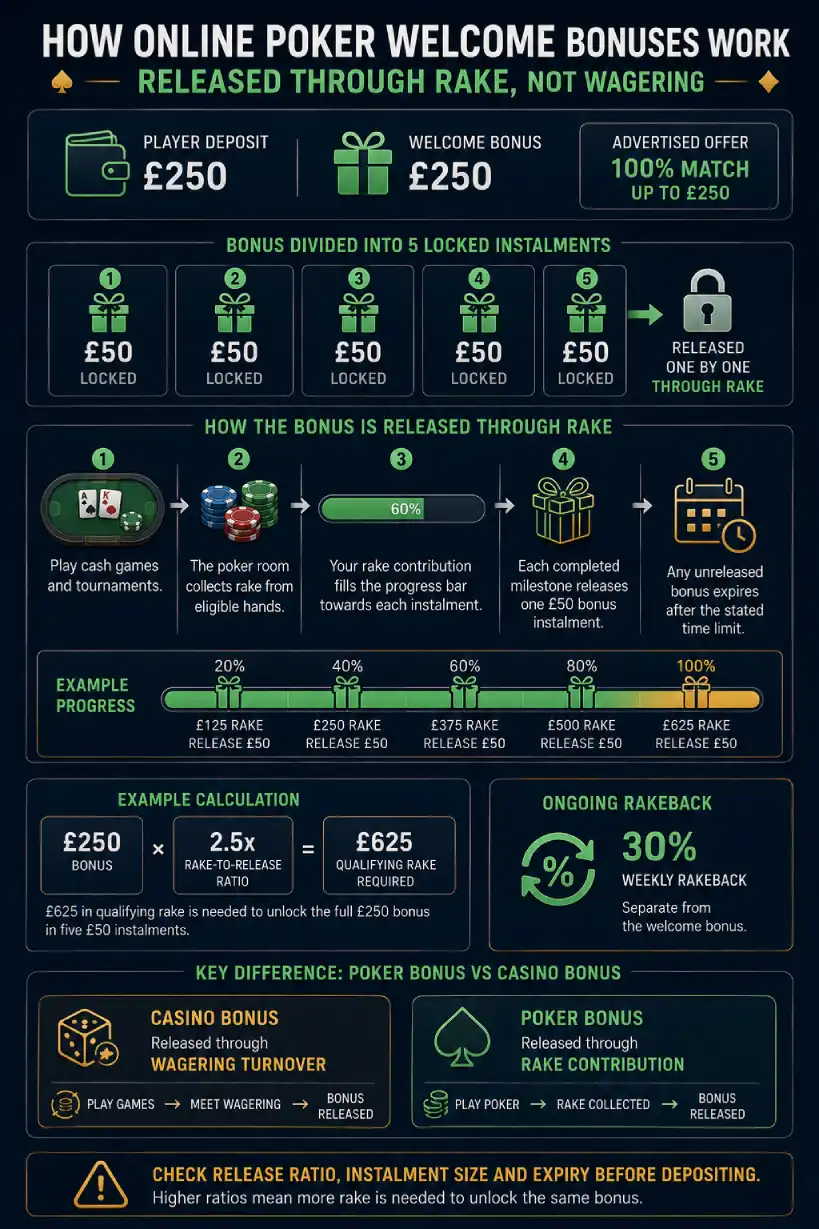
Welcome bonuses are typically deposit matches — 100% up to a stated ceiling is standard, though offshore sites will often go higher than that. You’ll usually have somewhere between 30 and 60 days to clear the full amount before any unreleased portion is forfeited, so it’s worth checking that window against how much you actually play before chasing a headline number that doesn’t suit your volume.
Reload bonuses work the same way but are aimed at existing players topping up their balance, and they’re almost always smaller than the initial welcome offer — a percentage match capped at a lower ceiling, cleared through the same rake mechanism.
Rakeback sits apart from both of these. It’s not a one-off bonus at all — it’s an ongoing return of a percentage of the rake you generate, paid out regularly (often weekly) for as long as you keep playing. This is arguably the most valuable long-term offer on the table for a regular player, more so than any single welcome package.
Freerolls and tournament tickets round out the picture. Freerolls cost nothing to enter but carry a real prize pool, which keeps the standard fairly low since there’s no financial commitment from entrants. Tournament tickets are more valuable in practice — they buy you into an event other players have paid real money to enter, which usually means a stronger prize pool for the same zero-cost entry.
In general, poker sites can offer larger bonus packages offshore because they are not bound by UKGC promotional limits. Still, a bigger headline figure does not automatically mean better value if the rake-release terms are unrealistic.
Poker Variants Available at Non-GamStop Poker Rooms
Hold’em and Omaha dominate the game selection at every serious non-GamStop poker room, but the variety beyond those two is worth knowing about if you want to diversify your play.
Texas Hold’em remains the easiest format to learn and by far the most heavily played, both in cash games and tournaments. No-Limit Hold’em is the standard version at nearly every stake level, though pot-limit and fixed-limit tables exist at some rooms for players who prefer a different betting structure.
Omaha, and specifically Pot-Limit Omaha, is the second pillar of the market. Four hole cards instead of two means more possible hand combinations and generally bigger action, which is why it tends to attract a slightly different — often more aggressive — playing style than Hold’em.
Short Deck (also called 6+ Hold’em) has grown steadily in popularity at offshore rooms over the past few years. Removing the 2s through 5s from the deck changes hand rankings — a flush beats a full house — and increases the frequency of strong hands overall, which makes for a faster, higher-variance game.
Seven Card Stud is rarer these days and tends to appear at only a handful of rooms, usually attracting a smaller, more experienced player base since there are no community cards to lean on.
Beyond these, you’ll occasionally find niche formats: PLO5 and PLO6 (five or six hole cards instead of Omaha’s standard four), Pineapple (a Hold’em variant where you discard one of three starting cards before the turn), and Razz (the lowball cousin of Seven Card Stud) — though these are more likely to show up during major online series than as part of a room’s everyday schedule.
A strong room should offer more than one poker game. The better operators usually provide a variety of poker games and a clear range of poker variants, rather than treating poker as a small add-on to a casino lobby.
Tournament Formats at Non-GamStop Poker Rooms
Cash games are only half the picture. Tournament formats at offshore rooms tend to be more varied than what you’ll find at a typical UKGC site, largely because of the bigger player pools feeding them.
Multi-table tournaments (MTTs) are the backbone of any serious tournament schedule — hundreds or thousands of entrants across many tables, competing down to a final table for a guaranteed prize pool. These run the full spectrum from micro buy-ins of a few pence up to signature events with five- and six-figure guarantees, and the biggest weekly events typically land on Sundays.
Sit & Gos start as soon as enough players register, rather than at a fixed time, which makes them a good fit if you want a shorter, more predictable session without committing to a multi-hour MTT.
Jackpot Sit & Gos add a randomised prize multiplier applied before the first hand, usually with three or four players and short starting stacks. The variance here is considerably higher than a standard Sit & Go — the format leans closer to a lottery than a skill contest for most of the field, which is worth knowing going in.
Freerolls cost nothing to enter and are a genuinely useful way to build a bankroll from zero, though the standard of play tends to be lower given the lack of financial buy-in.
Satellites let you win your way into bigger events for a fraction of the direct buy-in cost — sometimes for pennies, feeding into tournaments that would otherwise cost hundreds or thousands to enter outright.
Bounty tournaments put a cash reward on each opponent’s head, paid out to whoever knocks them out. That structure means you can walk away with a profit even if you don’t make a deep run, since eliminations pay in real time rather than only at the final payout.
For players used to local rooms, playing at online poker sites with international pools can feel different because schedules, prize guarantees and peak traffic often follow global demand rather than UK-only evening traffic.
Pros and Cons of Poker Rooms Not on GamStop
- Access even with an active GamStop self-exclusion
- Larger bonuses and rakeback deals than UKGC-regulated equivalents
- Crypto banking with near-instant deposits and fast withdrawals
- Bigger global player pools, meaning more traffic and larger guaranteed prize pools
- Lighter, often deposit-triggered rather than signup-triggered, verification
- No UKGC oversight and no access to UK dispute resolution services if something goes wrong
- Responsible gambling tools are often manual rather than automatically enforced
- Tournament schedules often favour US time zones over UK evenings
- Reputation varies enormously between operators, with no central UK registry to check against
The biggest advantage is flexibility: non GamStop sites can serve international audiences, offer crypto banking and provide broader poker schedules than some UK-only operators.
The main drawback is regulatory distance. Sites that operate outside the UK may still be licensed, but they do not give players the same complaint routes, safeguards or automatic GamStop enforcement as UKGC-linked rooms.
How We Rate Non-GamStop Poker Websites
Our process starts with the licence and doesn’t move past it if the site fails that first check. A room without credentials from a recognised authority — Curaçao, Malta, or a comparable jurisdiction — doesn’t make our recommendations regardless of how large its game library looks on paper.
From there, we look at five core areas: poker variant range across both cash games and tournaments, withdrawal processing time from request to funds landing, bonus transparency — specifically how clearly the rake-release mechanism is disclosed — payment method breadth, and how quickly support actually responds to a real query rather than a canned one. We register genuine accounts, deposit real funds, and go through at least one full withdrawal cycle before forming a view on any room. Sites that restrict withdrawals to a different method than the one used for deposit, or that delay payouts beyond what their own terms promise, get marked down accordingly.
This page is reviewed and updated regularly to reflect changes in licensing status, bonus terms, and banking options across the market.
We only include non GamStop poker websites when they provide enough public information to assess licensing, payments, bonuses and player protection. A site that’s not on GamStop still needs to meet a basic trust threshold before it belongs in any recommendation list.
Responsible Gambling at Non GamStop Poker Sites
Poker at a non-GamStop site is real-money gambling, and it carries the same financial and psychological risks as any other form. Because these rooms sit outside GamStop, the responsibility for setting your own limits falls more heavily on you than it would at a UKGC site with automated safeguards.
Watch for the warning signs: playing longer or more often than you’d planned, chasing losses, hiding your play from people close to you, borrowing to fund your bankroll, or feeling irritable when you can’t play. Any of these is worth taking seriously.
Most offshore rooms offer some combination of deposit limits, session time alerts, and internal self-exclusion — but you usually need to switch these on yourself through account settings rather than relying on them being active by default. Free, confidential support is available regardless of where you play:
- GamCare
- BeGambleAware
- National Gambling Helpline: 0808 8020 133
- Gordon Moody
Gambling can be addictive. Please play responsibly. Set limits and never gamble with money you can’t afford to lose. If you feel you’re losing control, please contact one of the support organisations listed above. 18+.
Non-GamStop poker sites operate outside UK regulatory protections, and GamStop self-exclusion doesn’t extend to them — if you’ve self-excluded because of a difficult period with gambling, that’s worth weighing carefully before signing up elsewhere.
This is the key responsible gambling point: sites operate outside the UK’s self-exclusion framework, so GamStop in the UK will not automatically stop access to offshore sites.
FAQs About GamStop Poker Sites for UK Players
Is it legal for UK players to use poker sites not on GamStop?
Yes. There’s no UK law stopping you playing at an offshore-licensed poker site. The UKGC only regulates its own licensees — offshore rooms sit outside that system entirely.
Are my poker winnings taxed in the UK?
No. UK gambling winnings, including poker, aren’t taxable for casual players, regardless of whether the site holds a UKGC or offshore licence.
Do I need a VPN to access these sites from the UK?
No. Non-GamStop poker sites accept UK players directly. A VPN isn’t required, and using one can sometimes breach a site’s own terms of service.
Is the software fair, or are these sites rigged?
Reputable non-GamStop rooms use independently audited RNG software and hold licences that require regular fairness checks. Stick to licensed, audited sites and this shouldn’t be a genuine concern.
Which non-GamStop poker sites have the best rakeback?
Rakeback varies by operator, typically ranging from around 20% up to 50% at the top end through VIP tiers. Always check the published percentage rather than a vague headline claim.
Do I need ID to sign up?
Most rooms use light-touch verification, often only requesting documents at your first withdrawal rather than at registration — though this varies by operator and by the size of the withdrawal.
What happens to my GamStop self-exclusion if I sign up at an offshore site?
GamStop only applies to UKGC-licensed operators. It has no bearing on offshore rooms, which is precisely why players who’ve self-excluded are still able to register there.
Do offshore poker rooms accept PayPal?
Almost never. PayPal is rare across the non-GamStop poker market — crypto, e-wallets like Skrill and Neteller, and cards are the standard alternatives.