
Last Updated on July 15, 2026
by David Flatcher
Best Offshore Online Casinos That Accept UK Players
If you’ve searched “offshore casinos” hoping for a straight answer rather than a wall of jargon, you’re in the right place — this guide is built for UK players seeking clarity, not more confusion. An offshore casino is simply an online casino licensed outside the UK — one of many licensed casinos in jurisdictions like Curaçao, Malta, Anjouan, or a handful of other jurisdictions, which means it isn’t tied to GamStop or the UK Gambling Commission’s rulebook. That’s the short version. The longer version — whether that’s legal, whether it’s safe, and which sites are actually worth your money — is what the rest of this guide covers.
We’ll get into GamStop specifically, because that’s the question most people are really asking even if they don’t phrase it that way. Then licensing, bonuses, payments, the warning signs of a dodgy operator, and finally a shortlist of top sites we’d actually point a friend towards. Skip to our shortlist if you already know the basics.
List of Best Offshore Gambling Sites We’d Actually Recommend
















What Is an Offshore Online Casino?
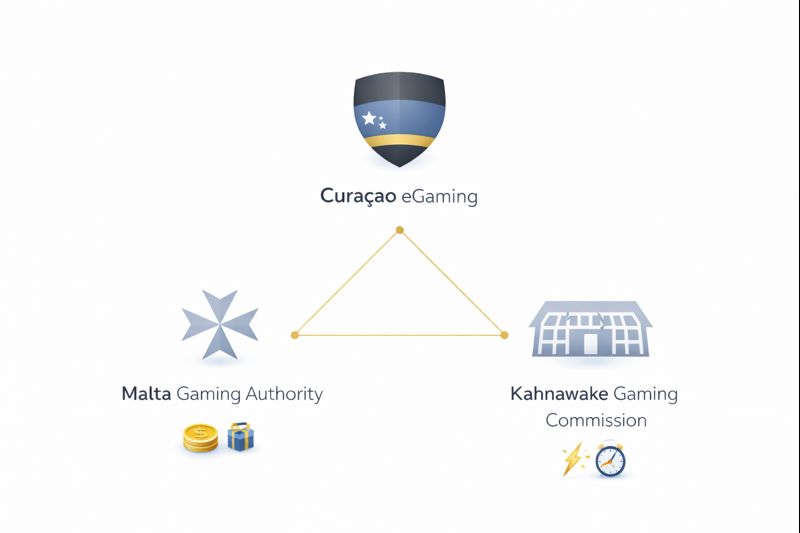
An offshore casino is an online gambling site licensed by a regulator outside the UK — part of the wider world of international online casinos operating beyond domestic rulebooks. That’s it — no mystery, no grey area. Curaçao, Malta, Anjouan, and Kahnawake are the names you’ll see most often on licence footers.
Because these operators sit outside UKGC jurisdiction, they don’t answer to the same rulebook that governs British-licensed sites, otherwise known as UK casinos. That covers everything from how bonuses are advertised to how account verification works to what a casino is required to check before letting you deposit. It doesn’t mean no rules exist — Curaçao and Malta both have their own licensing conditions — it just means the rules are different, and in some cases lighter, than what you’d find at a UKGC operator.
You’ll also see the term “non-GamStop casino” used more or less interchangeably with an offshore casino online in this niche. They’re describing the same thing from two angles: one focuses on where the licence comes from, the other on what that licence means practically for someone who’s used GamStop before. Both terms point at the same pool of sites.
Worth flagging early: offshore doesn’t automatically mean risky, and it doesn’t automatically mean casinos are safe either. The word tells you about jurisdiction, not quality. That distinction matters more than anything else in this guide.
It’s worth understanding why so many casinos operate outside UK regulation rather than applying for a UKGC one. Licensing fees and compliance costs are considerably lower outside the UK, and the rules around bonus structuring, KYC timing, and game availability are less prescriptive. That’s not automatically a red flag — it’s a different regulatory model, and plenty of well-run operators choose it for straightforward commercial reasons rather than to dodge oversight altogether. The trade-off lands on the player’s side: fewer built-in restrictions, but also fewer guaranteed protections if something goes wrong.
Structurally, a lot of offshore casinos feature shared back-end platforms across wider operator groups running several branded sites — shared game libraries, shared cashier systems, sometimes shared support teams. That’s not unusual or inherently a problem, but it does mean two casinos that look completely different on the surface can behave near-identically underneath. Knowing this helps explain why some of the criticisms and praise you’ll read about one offshore brand often apply just as well to a handful of others in the same family.
Can GamStop Block You from Playing at Offshore Casinos?
No. GamStop only applies to operators licensed by the UK Gambling Commission. These are casinos with offshore licences issued elsewhere, so they sit outside the scheme entirely and have no mechanism to check your GamStop status.
This is the honest answer, and it’s worth stating plainly rather than dancing around it, because it’s the exact question a lot of people searching this term actually have. If you’ve self-excluded through GamStop, whether that was during a difficult stretch or simply because you wanted a break, that exclusion is enforced by UKGC-licensed sites checking a shared database. Offshore operators aren’t part of that database and have no obligation to consult it.
What that means in practice: registration at a non-GamStop casino generally isn’t blocked by your GamStop status, and these are exactly the kind of sites that accept players regardless of self-exclusion history. Verification requirements vary from site to site — some ask for ID before your first withdrawal, others earlier — but none of them are cross-referencing GamStop as part of that process.
It’s also worth being upfront that this cuts both ways. The protections built into GamStop exist for a reason, and stepping outside that system means stepping outside those particular safeguards too. Most offshore casinos do offer their own responsible gambling tools — deposit limits, session timers, self-exclusion options — but they’re managed independently by each operator rather than through a shared national scheme across offshore gambling platforms. If you do choose to play at a non-GamStop site, it’s worth setting your own limits from day one rather than relying on the platform to catch you.
There’s also a practical difference in how self-exclusion works if you ever want it. GamStop, once activated, applies across every UKGC-licensed site simultaneously — one action, blanket coverage. An offshore casino’s self-exclusion tool, by contrast, only applies to that one operator. If you’re playing across two or three non-GamStop sites at once, closing your account on one doesn’t touch the others — a common pattern among offshore operators — so the responsibility for consistency sits with you rather than a shared system. That’s a meaningful practical difference worth factoring in if managing your own limits is part of why you’re reading this in the first place.
None of this is a moral judgement on the choice to play offshore, which is entirely legal for uk residents — plenty of people do it for entirely ordinary reasons, from wanting a bigger game library to disliking the affordability checks that UKGC sites have leaned on more heavily in recent years. It’s simply worth knowing exactly what you’re opting into and out of before you register anywhere.
Is It Legal for UK Players to Play at Offshore Casinos?
Yes. UK law doesn’t stop residents from playing at offshore casinos, and there’s no legal penalty for registering, depositing real money, or withdrawing at one.
The Gambling Act 2005 is the piece of legislation that governs online gambling in Great Britain, and it’s aimed squarely at operators rather than players. It sets out licensing requirements for any company wanting to advertise or actively target the UK market, but it doesn’t criminalise a UK resident for using a site licensed somewhere else — these casino sites don’t need a UK licence to legally accept UK customers. That’s a meaningful distinction: the restrictions sit on the operator’s side of the transaction, not yours.
Where things get more interesting is advertising and marketing. UKGC-unlicensed operators aren’t supposed to actively advertise to UK consumers, which is part of why you won’t see offshore casino ads during a Premier League match the way you might for a UKGC brand. That restriction affects how these new offshore operators can promote themselves, not whether you’re allowed to use them.
One more point worth clarifying while we’re here, since it comes up a lot: winnings from offshore casinos aren’t taxed in the UK. HMRC doesn’t treat gambling winnings as taxable income for recreational players, regardless of where the casino holding your account happens to be licensed, whether you bet casually or regularly. The rules differ for professional gamblers, but that’s a niche case that won’t apply to the vast majority of readers.
Where legality does get genuinely more complicated is dispute resolution. If something goes wrong at a UKGC-licensed casino, you’ve got a formal route through the regulator and, in some cases, the Financial Ombudsman. At an offshore casino, the first step is usually to contact the casino directly before that route runs through the licensing authority instead — Curaçao’s GCB, the MGA, or whichever body issued the licence — and how well that process works varies a lot depending on which regulator you’re dealing with. It’s not a legal grey area exactly, just a different, and sometimes slower, escalation path.
Offshore Casinos vs UK-Licensed Casino Sites: The Real Differences
Rather than treating this as a good-versus-bad comparison, it’s more useful to look at where the two models genuinely diverge, since that’s what should actually drive your decision when comparing the best online options in each category.
| Feature | Offshore Casinos | UKGC-Licensed Casinos |
|---|---|---|
| Regulation | Curaçao, Malta, Anjouan, Kahnawake, and similar | Must hold a UK Gambling Commission licence |
| GamStop | Not part of the scheme | Mandatory enrolment check |
| Payment methods | Cards, crypto, e-wallets, bank transfer | Debit cards, e-wallets, bank transfer — credit cards and crypto banned |
| Bonus structure | Larger, fewer restrictions | Capped and more tightly regulated |
| KYC timing | Often at withdrawal rather than signup | Typically required before or at first deposit |
| Dispute resolution | Through the offshore licensing authority | Through UKGC and, in some cases, the Financial Ombudsman |
| Responsible gambling tools | Vary by operator, no shared scheme | Standardised, shared GamStop enrolment |
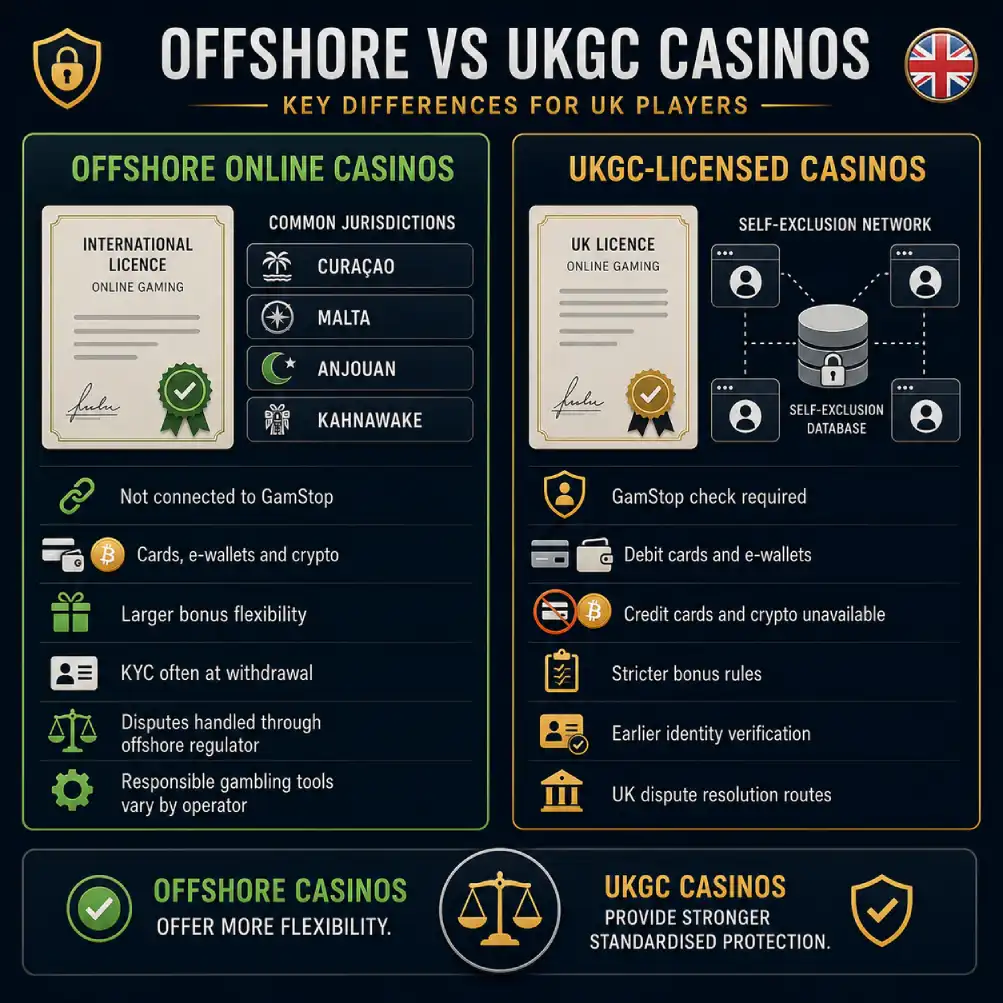
Neither column is universally “better” — it depends entirely on what you’re prioritising. Someone who wants tighter guardrails and a shared national self-exclusion scheme is better served by a UKGC site. Someone who wants a broader game library, credit card or crypto payments, and isn’t affected by GamStop enrolment may find the offshore side of the market, including many international casinos, suits them more. The important thing is knowing which trade-offs you’re actually making rather than assuming one side is simply the “safe” option and the other isn’t.
Best Offshore Online Casinos for UK Players – August 2026
We’ve tested each of the sites below first-hand — registering an account, checking the licence against the regulator’s own register, and going through the deposit and withdrawal process ourselves — rather than repeating marketing copy, since the goal is to help you find the best offshore casino for your needs. Full breakdowns of bonuses, game libraries, and payment specifics sit in each dedicated review; the summaries here are a starting point, not the whole picture.
Wildzy Casino — A solid pick if you want a broad catalogue of casino games alongside straightforward account verification. It’s built around a clean, modern interface rather than a cluttered one, which makes it an easier starting point if you’re newer to offshore casinos generally. Read the full Wildzy review for the bonus breakdown and our withdrawal testing notes.
Wino Casino — Worth a look if crypto payments are your priority; withdrawal processing has generally been quicker through that route than via card. Its promotions run fairly regularly rather than being a one-off welcome offer and nothing after, reflecting the range of games available at offshore operators broadly. See the full Wino Casino review for exact terms.
Mr Jones Casino — Leans into a more curated game selection with a focus on live dealer content, one of the few casinos to offer this level of polish, which suits players who want quality over sheer volume. Support responsiveness has been a consistent strength in our testing. Check the full Mr Jones Casino review before you sign up.
Extreme Spins Casino — A slots-first operator, unsurprisingly, with a catalogue weighted heavily towards that side of the library. Worth considering if table games and live dealer aren’t your main interest and you’d rather see more reel variety. Full details in the Extreme Spins review.
Hello Fortune Casino — Newer to the market than some of the other offshore casinos on our list, with a loyalty structure that’s worth understanding before you commit to one casino long-term, since the value compounds the longer you stay. Read the full Hello Fortune review for our verdict on how that scales.
Each of these has its own licence, its own specific bonus terms, and its own payout track record — details that genuinely differ across this list of offshore casinos and deserve more space than a single paragraph here can give. That’s exactly what the individual reviews are for.
Are Offshore Casinos Safe for UK Players?
Some are, some genuinely aren’t, and the difference comes down to specific, checkable things rather than a gut feeling. Safety isn’t a vibe you pick up from a slick homepage — it’s a licence you can verify, encryption you can confirm, and a payout history you can research before you deposit a penny, since offshore casinos offer vastly different levels of protection.
Start with the licence. A legitimate offshore casino displays its licence number clearly, usually in the footer, and that number should match an entry on the regulator’s own public register — not just appear on the casino’s own “About Us” page, which tells you nothing on its own. Curaçao’s register and Malta’s register are both searchable directly for curacao casinos and Maltese-licensed operators alike, and it takes about thirty seconds to check.
Beyond licensing, a handful of concrete markers separate the sites worth your time from the ones to avoid:
- SSL encryption on every page, not just the login screen — check for the padlock icon in your browser and make sure it holds across the cashier pages too.
- Independent game testing of casino games, usually from labs like eCOGRA, iTech Labs, or GLI, with certificates that are dated and specific rather than a vague “audited” claim with no evidence behind it.
- Transparent T&Cs, meaning bonus terms, wagering requirements, and withdrawal limits are stated clearly on the site itself rather than buried in a PDF you have to hunt for.
- A track record, which is really the strongest signal of all — a casino that’s been paying out consistently for a year or more tells you more than any badge on its homepage.
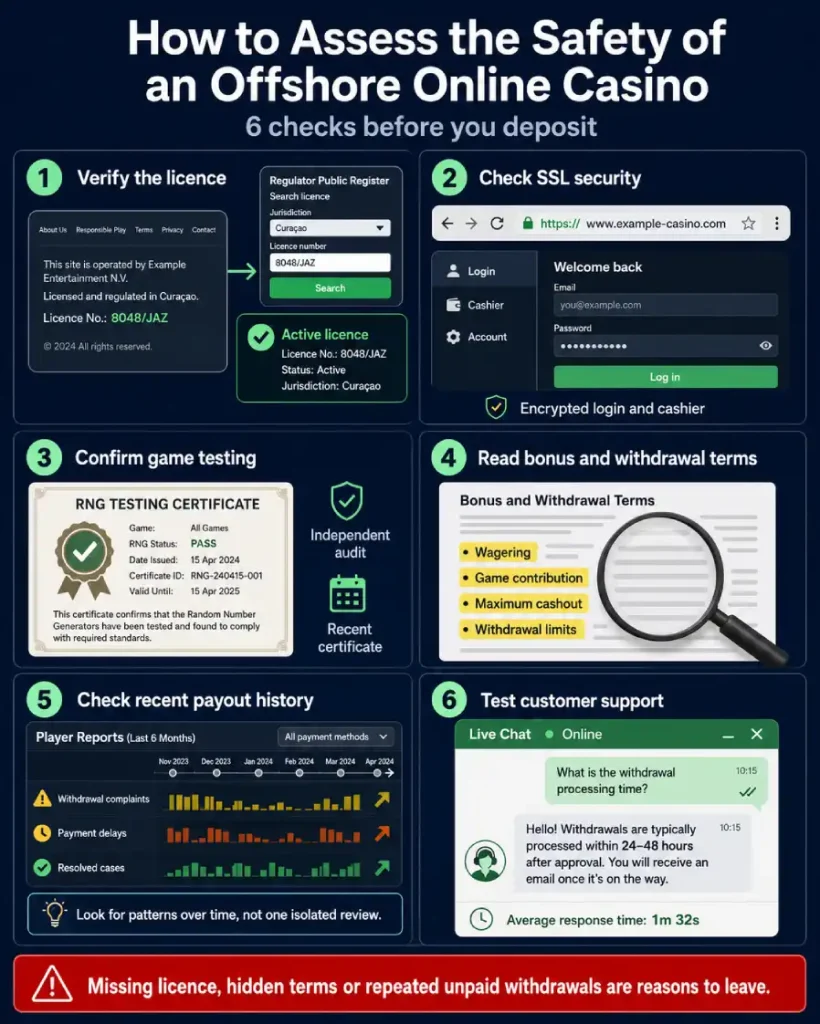
We test the criteria above first-hand for every casino we review, holding each to the standard we’d expect from reputable offshore casinos — registering an account, checking the licence against the regulator, and going through a real withdrawal — rather than repeating the operator’s own marketing claims back at you. That’s the standard behind every recommendation in this guide.
It’s also worth knowing where to actually look for that track record, since “check reviews” is easy advice to give and harder to act on well. Independent platforms and dedicated gambling forums tend to surface genuine patterns of complaint faster than a casino’s own testimonials page ever will, precisely because there’s no incentive to only show the good ones, and offshore sites may otherwise curate only positive testimonials on their own pages. What’s worth paying attention to is a repeated, specific complaint: the same withdrawal delay, the same unresponsive support, the same shifted bonus term, showing up across multiple unconnected accounts over a period of months rather than days.
Five things worth checking before you deposit anywhere:
- Does the licence number on the footer match an entry on the regulator’s own register?
- Is there a visible testing lab certificate, and is it dated recently?
- Are the wagering requirements stated in plain terms, not hidden three clicks deep?
- Does an independent search turn up a pattern of unpaid withdrawal complaints?
- Is customer support actually reachable, or does live chat just loop you to a bot?
Not all licences carry the same weight, and knowing the difference between them saves you from assuming a footer badge means more than it actually does. A licence makes an operator — one of many offshore licensed casinos — accountable to somebody, and the real question is how much that somebody actually enforces.
Here’s how the main jurisdictions you’ll encounter stack up:
| Authority | Region | What It Enforces | Player Recourse |
|---|---|---|---|
| Curaçao Gaming Control Board | Caribbean (Curaçao) | Consolidated oversight since 2023 reforms; baseline fairness and AML/KYC requirements | Complaints route through the GCB; enforcement has strengthened but still varies by case |
| Malta Gaming Authority | EU (Malta) | Strict technical standards, consumer protection, strong compliance culture | Formal dispute process with an established regulator, generally the strongest of the group |
| Anjouan Gaming Commission | Comoros | Defined application standards, increasingly popular with newer operators | Newer regulatory body; oversight is developing rather than long-established |
| Kahnawake Gaming Commission | Canada (Mohawk Territory) | Long-running licensing body with a public complaints channel | Established track record, though largely US/Canada-facing historically |
Curaçao Gaming Control Board. This is the licence you’ll see most often across the top offshore casino space, and it’s had a genuine shake-up in recent years — the old “master licence” sub-licensing system was consolidated under direct GCB oversight, which tightened things up considerably compared to a few years back. It’s still a lighter-touch regulator than Malta, but it’s no longer the free-for-all it’s sometimes reputed to be.
Malta Gaming Authority. If you want the closest thing to a UKGC-equivalent outside the UK, this is generally it, and it’s why Malta-licensed operators often top lists of best offshore casino sites. Malta’s licensing conditions cover technical fairness standards and consumer protection requirements in more depth than most offshore alternatives, and its enforcement history backs that up. Casinos holding an MGA licence tend to sit a notch above pure-Curaçao operators in terms of scrutiny.
Anjouan and Kahnawake. Anjouan has become a popular choice for newer, tech-forward operators, including many casinos based in emerging jurisdictions, over the past couple of years, with clearer application standards than its reputation sometimes suggests, though its regulatory track record is still relatively young compared to the others here. Kahnawake, by contrast, has been licensing online gambling operators for decades and runs a public complaints channel, though it’s historically been more associated with the North American market than UK-facing sites.
The takeaway: a licence tells you an operator answers to somebody, but the strength of that “somebody” varies a lot. Always check the specific licence number against the regulator’s own register rather than assuming any offshore licence is interchangeable with another.
What Makes Offshore Casino Bonuses Different?
Offshore casino bonuses are generally bigger and less restricted than what you’ll find at a UKGC-licensed site, because operators outside UK regulation aren’t bound by the same caps on promotional value and structure. That’s the headline difference — the details vary enormously from one casino to the next.
UKGC rules place fairly tight limits on how casinos can advertise and structure bonuses, partly as a consumer protection measure. Offshore operators don’t work under those same constraints, which is part of why you’ll see a bigger welcome bonus, reload bonuses, and cashback offers that look considerably more generous on paper than their UK-regulated equivalents.
That extra generosity comes with a catch worth understanding before you claim anything: bigger headline numbers don’t automatically mean better value. A large match percentage attached to a steep wagering requirement can end up worse than a modest amount of bonus funds with fair terms. This is exactly where it pays to read the specific terms for the specific casino you’re looking at, rather than assuming all offshore bonuses follow the same pattern — because they genuinely don’t. We break down the actual wagering, contribution rates, and expiry windows for each brand in our individual reviews rather than quoting universal numbers here, since the terms differ meaningfully casino to casino.
What tends to differ from UKGC sites:
- Higher match percentages and larger maximum bonus values
- More frequent reload, free spins, and cashback promotions
- Fewer restrictions on which payment methods qualify for a welcome offer
- VIP and loyalty schemes that can be more generous at the top tiers
Worth checking before you claim any bonus across your first deposit, regardless of the casino:
- The wagering requirement, and whether it applies to the bonus alone or the bonus plus your deposit
- Which games count towards clearing it, and at what contribution rate
- The expiry window — some bonuses vanish faster than you’d expect
- Any maximum cashout cap on bonus winnings
It’s also worth understanding the mechanics behind why offshore bonuses can afford to look bigger. A UKGC-licensed operator has to build its promotional budget around rules that cap how offers are structured and marketed, which naturally limits headline size. An offshore operator, working under a lighter regulatory model, has more room to advertise larger match percentages, which is why offshore online casinos often attach tougher conditions to clearing them — but that same flexibility applies to how wagering requirements, game restrictions, and expiry windows are set too. In other words, the same lack of restriction that lets a casino advertise a bigger number also lets it attach tougher conditions to clearing it, and there’s no universal rule dictating which way any given operator has chosen to go. That’s precisely why reading the specific terms matters more here than it does at a UKGC site, where the range of possible outcomes is narrower to begin with.
Loyalty and VIP schemes deserve a similar note of caution. Offshore casinos often run multi-tier programmes with genuinely strong perks at the top — the best offshore casinos offer priority withdrawals, dedicated account managers, enhanced cashback — but climbing those tiers usually requires sustained volume over weeks or months, not a single big session. If a loyalty programme is a deciding factor for you, it’s worth checking how realistic reaching the higher tiers actually is given your typical play pattern, rather than being drawn in by what the top tier alone looks like on paper.
Payment Method Options at Offshore Online Casinos
Offshore casinos, much like other offshore online casino sites, generally support a wider range of payment methods than UKGC sites, including options like credit cards and cryptocurrencies that UK-regulated operators aren’t permitted to offer. Speed and convenience vary a lot by method, so it’s worth knowing what to expect before you pick one.
| Method | Typical Deposit Speed | Typical Withdrawal Speed | Notes |
|---|---|---|---|
| Cryptocurrency | Minutes | Hours in many cases | Fastest option overall; value can fluctuate with the market |
| E-wallets (Skrill, Neteller, and similar) | Instant | Same day to 24 hours at many sites | Widely accepted; some promotions exclude e-wallet deposits |
| Debit/credit cards | Instant | Can take several business days | Credit cards are common offshore but banned under UKGC rules |
| Bank transfer | 1-3 business days | Several business days | Best for larger sums; slowest option in most cases |
| Prepaid vouchers | Instant | Often not supported for withdrawal | Useful for deposits only; you’ll need a separate method to cash out |
Crypto tends to be the quickest route in both directions, largely because it cuts out the intermediary banking steps that slow everything else down. That said, exact processing times differ from operator to operator, and a casino’s own stated timeframes are worth checking against real player feedback rather than taking at face value.
Credit cards are worth a specific mention, since it’s one of the clearest practical differences from the UK-regulated market — the UKGC banned credit card gambling deposits back in 2020, but that restriction doesn’t extend to offshore operators, so you’ll still find it as an option at plenty of non GamStop casinos accepting uk players.
One practical habit worth building in regardless of which method you pick: verify your documents and have a backup withdrawal method sorted before you win anything significant. Card deposits, in particular, often can’t be used for withdrawals at all, so you’ll need an e-wallet or bank transfer route ready before that becomes a problem rather than after.
KYC verification is the other piece of the payments picture worth understanding, since it affects how quickly any of the above methods actually pay out in practice. Offshore casinos frequently take a lighter-touch approach than UKGC sites when it comes to timing — some don’t ask for ID documents until you request your first withdrawal, rather than at registration. That’s convenient in one sense, since it means faster signup, but it also means the first withdrawal at a new casino is often the slowest one you’ll experience there, simply because that’s when verification actually happens. Uploading clear, valid documents proactively, before you’ve even won anything, is one of the simplest ways to avoid a delay later.
It’s also worth being realistic about fees. Crypto transactions typically carry network fees rather than a casino-imposed charge, which can vary depending on blockchain congestion at the time you withdraw. Card and bank transfer fees, where they exist, tend to sit with the payment processor rather than the casino itself, though a small number of operators do pass on their own handling charge. Checking the cashier page’s stated fee structure before you deposit avoids an unwelcome surprise at withdrawal time.
How to Spot Unsafe Offshore Casino Sites
Most offshore casinos operate properly, but the ones that don’t tend to show the same handful of warning signs, and they’re worth knowing before you deposit rather than after something’s gone wrong.
Red flags worth taking seriously:
- No licence displayed, or one you can’t verify. A legitimate operator shows its licence number clearly and that number checks out against the regulator’s own register. If you can’t confirm it independently, that’s not a technicality — it’s the whole point of having a licence in the first place.
- Bonus terms that shift after you deposit. Wagering requirements or restrictions that change once your money is already in the account are a serious sign of bad faith, not an oversight.
- Vague or buried T&Cs. If the withdrawal policy or bonus rules are hard to find or written to be deliberately confusing, that’s rarely accidental.
- Slow or evasive support. A casino that can’t answer a straight question about withdrawal timelines within a reasonable window usually has something it would rather you didn’t ask about.
- A pattern of unpaid withdrawal complaints. One angry review means little on its own. A consistent pattern across independent forums and review platforms over time means a great deal.
- Pressure tactics. Countdown timers, aggressive pop-ups, or urgency-driven marketing pushing you to deposit quickly are a classic sign of an operator more interested in a quick sign-up than a long-term relationship with its players.
None of these signs are damning in isolation — every casino gets the occasional bad review — but the pattern is what matters. A single complaint about a slow withdrawal is normal. Dozens of similar complaints over months, with no resolution and no response from the operator, is a completely different story.
There’s a simple, low-effort test worth running before you commit any serious money to a new casino: deposit a modest amount, play normally, and request a small withdrawal early on rather than waiting until you’ve built up a larger balance. How smoothly that first, low-stakes withdrawal goes tells you far more about an operator’s genuine reliability than anything on its homepage. If it lands cleanly and within the timeframe the casino itself quoted, that’s a good sign for bigger sessions later. If it stalls, gets delayed with vague explanations, or support goes quiet, you’ve found out cheaply rather than after a significant win is sitting in limbo.
Overseas Casinos for UK Players FAQ
Is it legal for UK players to use offshore casinos?
Yes. The Gambling Act 2005 doesn’t stop UK residents from playing at offshore sites — it restricts unlicensed operators from actively advertising here, not players from using them. You won’t face legal trouble for registering, depositing, or withdrawing.
Can I play at an offshore casino if I’m registered with GamStop?
Yes. GamStop only covers UKGC-licensed operators, so offshore sites licensed elsewhere sit outside that scheme and have no way to check your GamStop status.
Do I pay tax on offshore casino winnings in the UK?
No. HMRC doesn’t treat gambling winnings as taxable income for UK residents, whether the casino is UK-licensed or offshore. The exception is professional gamblers, which won’t apply to most players.
What licence should I look for at an offshore casino?
Curaçao, Malta, Anjouan, and Kahnawake are the ones you’ll see most often. Malta generally carries the strongest player protections. Whichever licence a casino holds, check the number against the regulator’s own public register before you deposit.
Do offshore casinos pay out faster than UK sites?
Often, yes, particularly with crypto, where withdrawals can land within hours. But speed varies considerably by operator and payment method, so it’s worth checking the specifics for the casino you’re considering rather than assuming.
How do I know if an offshore casino is legit?
Verify the licence number directly against the regulator’s own register, check that T&Cs are clear rather than buried, and look for a consistent, complaint-free withdrawal history over time rather than just a handful of good reviews.
Are offshore casino bonuses actually worth claiming?
Often, but not automatically. Bigger headline numbers can hide steeper wagering requirements, so it’s worth reading the specific terms — contribution rates, expiry windows, and any cashout cap — before deciding a bonus is genuinely good value.
What happens if I have a problem with an offshore casino?
Start with the casino’s own support team and put your complaint in writing, keeping a clear record of dates and what was said. If that goes nowhere, the licensing authority itself — Curaçao GCB, MGA, or whichever regulator applies — has its own complaints process, though how well that’s enforced varies by jurisdiction.
Do offshore casinos check my identity the same way UK sites do?
Not always at the same point. UKGC sites typically verify ID before or at your first deposit. Many offshore casinos instead run KYC checks at your first withdrawal, which is faster to sign up but can slow down that initial payout, so uploading documents early is worth doing.
Can I use the same account across multiple devices?
Yes, most offshore casinos work the same way UKGC sites do here — log in with your usual credentials on desktop or mobile and your balance, history, and any active bonus carry across both without needing a separate registration.
Offshore casinos aren’t inherently risky, and they aren’t automatically safe either — the word describes where a licence comes from, not the quality of the operator behind it. The sites worth your time are the ones with a licence you can actually verify, clear terms, and a payout history that holds up under scrutiny, and that’s exactly what separates the five casinos above from the ones on nobody’s shortlist.
Whichever way you decide to play, the basics are worth repeating: check the licence yourself rather than taking a footer badge on trust, read the specific bonus terms rather than the headline number, and start with a small, low-stakes withdrawal before you commit anything larger. None of that takes long, and all of it is the difference between a genuinely good offshore casino experience and a frustrating one.
Gambling can be addictive. Please play responsibly, set limits, and never gamble with money you can’t afford to lose. If you feel you’re losing control, GamCare, BeGambleAware, and the National Gambling Helpline (0808 8020 133) are there to help. 18+.